CHRISTIE'S · POST-SALE LEAD · SELF-INITIATED
Making the wait visible.
Under 20% of clients completed checkout on their own, and the team’s answer was more staff. I tested whether that was true.
- fewer escalations
- 40%
- fewer escalations
- paid and shipped within 30 days, usually ~60%
- 90%
- paid and shipped within 30 days, usually ~60%
- estimated yearly saving
- ~£50k
- estimated yearly saving
- Problem framing
- Research design
- Service blueprint
- Figma + prototype
- Experiment design
I led the framing, research, blueprint, design and experiment. Engineering feasibility and department adoption were owned by others.
WHY THIS PROBLEM
An assumption nobody had tested.
Inside the team, hand-holding was seen as the cost of high-value sales. I focused on first-time buyers: the most anxious, the most digital, and the future of contemporary art sales.
Every escalation also carried a direct cost.
- £200 to 3,000
- waived shipping
- £3,000 to 6,000
- reduced premium
- £10,000+
- cancelled sale
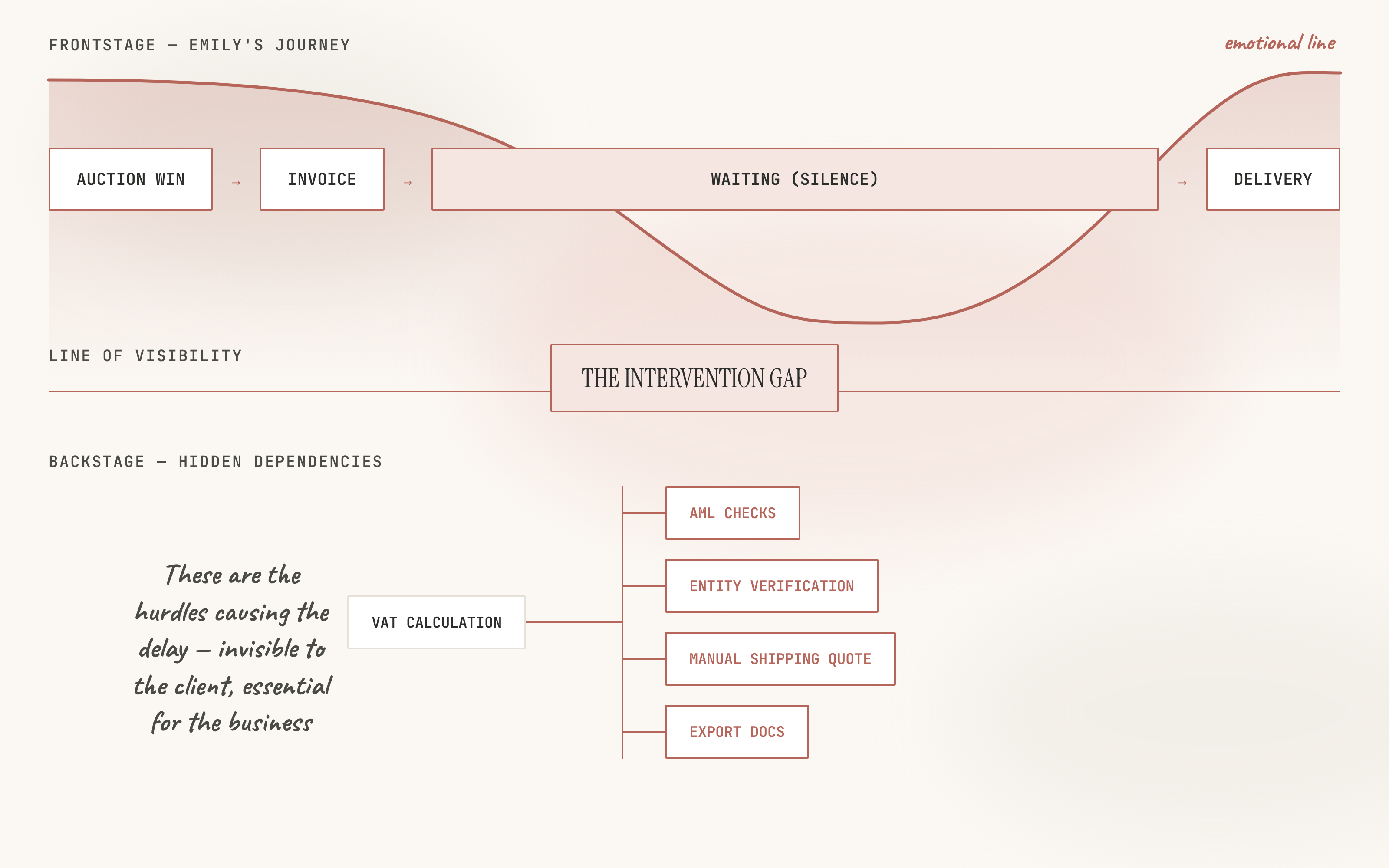
stress peaked during the silence
WHAT I FOUND
The real problem was silence.
Six months embedded in post-sale. I audited the portal with the UX team, coded 100+ escalation emails and 30+ call notes with AI-assisted categorisation, and bid in a real auction myself.
68% · Timeline anxiety
“It’s been 10 days and nothing.”
22% · Compliance confusion
“Why do you need my company documents for a personal purchase?”
9% · Contact uncertainty
“Who should I contact about shipping?”
The portal was built for pre-sale browsing. After “Check out” there were no stages, no timeline and no named contact. Behind the scenes, every team was doing its job correctly. No one could see how their piece landed as one journey.
- Timeline
- Plain-language compliance
- Named contact
WHAT I DESIGNED
A reassurance layer for the portal.
A post-sale status view with three parts: each stage and its timeline, the work behind it in plain language, and a named contact from day one.
I designed it in Figma, then built a working prototype in Cursor. I showed it to the engineering lead and senior stakeholders in the same session, so they reacted to something that behaved like the real portal.
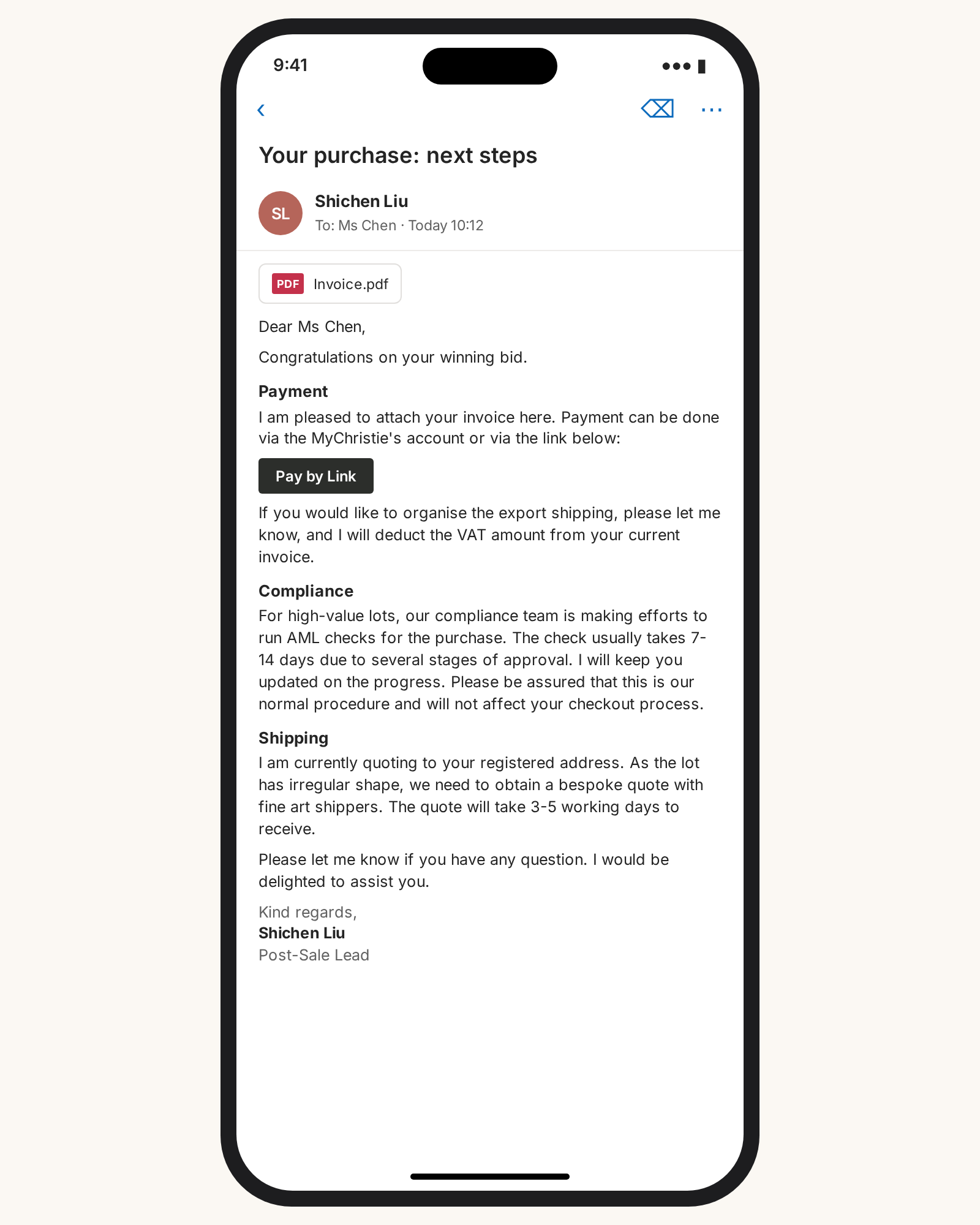
CONSTRAINT → PILOT
Same hypothesis, no engineering needed.
That session surfaced the constraint: the legacy system couldn’t show real-time status, and a live portal needed a backend build outside scope. So I delivered the same three things in one structured client message, and tested it inside live operations.
Two seasons of first-time contemporary art buyers, compared with previous seasons and with other sales running at the same time. Metrics were set before it started.
~30 new buyers a season. Too few to split, so everyone got the better version.
RESULT
The pilot became the business case.
40% fewer escalations. 90% of buyers completed payment and shipping within 30 days, against a usual ~60%. 80% of the department adopted the template, beyond first-time buyers. About £50k a year saved in compensation.
The portal design is ready, and the pilot is now the case for the backend work it needs.
It was my first time buying with Christie’s, and it was such a smooth procedure.
WHAT I LEARNED
Product doesn’t always need to change operations. It needs to make the invisible understandable.
Next time I’d bring engineering in at the first sketch. And with AI synthesis, I’d go back through the archive and build a far larger dataset.
NEXT CASE
HabitHero
Design craft, end to end.